
Industry News · Oct 8, 2026
AI data center power infrastructure connected to the electrical grid with transformers switchgear UPS and battery energy storage
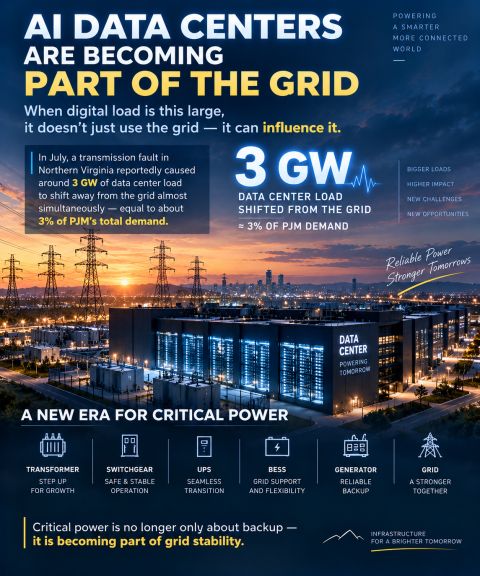
As AI data centers continue to scale, their enormous and rapidly changing electricity demand is creating a new challenge for power grids. A reported 3 GW load shift in Northern Virginia highlights how data center power infrastructure is evolving from a backup-power concern into a critical component of grid stability. Transformers, switchgear, UPS systems, BESS, generators and grid connections must increasingly operate as one coordinated power architecture.
Industry News
What Happens When a Data Center Becomes Big Enough to Disturb the Grid? This is no longer just a theoretical question. In July, a transmission fault in Northern Virginia reportedly caused around 3 GW of data center load to shift away from the grid almost simultaneously. Think about that for a moment. For years, the critical power conversation around data centers was mainly focused on one question: Can the facility stay online when the grid fails? But AI is changing the scale of the problem. As AI data centers become larger and more power-intensive, their electricity demand can reach levels that are significant not only for individual facilities, but also for the surrounding power system. When gigawatts of digital load can disappear from — or reconnect to — the grid within a very short period, critical power is no longer simply about backup. It becomes part of grid stability. This changes how we should think about data center power infrastructure. Transformer. Switchgear. UPS. BESS. Generator. Grid. These are no longer isolated systems. They need to work together as one coordinated power architecture. For equipment manufacturers and power infrastructure providers, this creates a new set of opportunities and challenges. Transformers need to support increasingly large and concentrated loads. Switchgear needs to provide reliable protection, isolation and fast coordination. UPS systems need to maintain power quality and continuity for highly sensitive computing equipment. Battery Energy Storage Systems can provide additional flexibility for managing power demand and supporting grid interaction. Generators remain an important part of backup and resilience strategies, but their role increasingly needs to be considered alongside other distributed energy resources. Most importantly, the connection between the data center and the grid needs to be designed as an integrated system rather than a collection of individual components. As AI data centers continue to grow, the next opportunity will not simply be building more computing capacity. It will be building the power infrastructure capable of supporting it. AI infrastructure is becoming power infrastructure. And power infrastructure is becoming a critical part of the AI ecosystem.
Need product selection support, drawings review, or a BOQ quotation?
Submit RFQ